Few pieces of running gear attract as much hype, and as much confusion, as the compression sock. Walk any start line and you will see a wall of tall, snug socks, but ask ten runners why they wear them and you will get ten different answers. Underneath the marketing, compression socks are a specific, measurable product with a real medical lineage, and understanding how they are graded makes it far easier to decide whether you need them and, if you are ordering a custom pair, exactly what to spec. Here is what the numbers on the label mean and what the research actually supports.
What “graduated compression” actually means
A true compression sock is not just tight. It applies graduated compression, meaning the pressure is strongest at the ankle and eases gradually up the calf. That gradient is the whole design principle: by squeezing hardest at the bottom, the sock is meant to help push blood back up toward the heart against gravity, which is why the technology started in clinical settings for circulation and swelling. The pressure is measured in millimeters of mercury, written as mmHg, the same unit used for blood pressure. A label reading “15–20 mmHg” means roughly 15 to 20 mmHg of pressure at the ankle, tapering off higher up. If a sock does not state an mmHg figure, it is almost certainly a snug athletic sock rather than a graduated compression garment, and the distinction matters when you are buying for a reason.
The compression levels, from athletic to medical
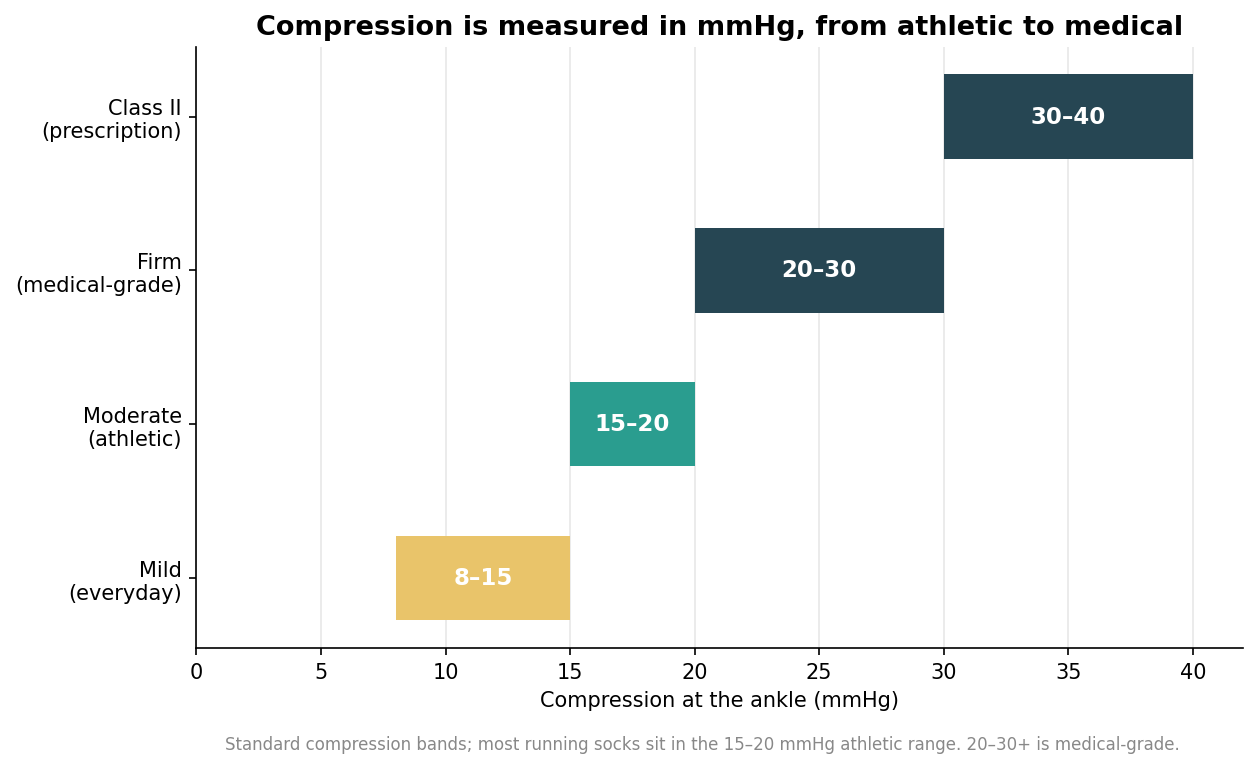
Compression is sold in standard bands, and they are not interchangeable. Mild compression, around 8 to 15 mmHg, is everyday light support. The 15 to 20 mmHg band is the moderate, over-the-counter athletic range, and it is where the large majority of running socks sit — enough to feel supportive without needing a prescription. Firm compression of 20 to 30 mmHg is medical-grade, used for recovery and for conditions like varicose veins, and while it does not legally require a prescription in most places, it is strong enough that it is worth choosing deliberately. Anything at 30 to 40 mmHg and above is medical class II, genuinely prescription territory, and not something a runner should reach for casually. The chart below lays the bands out side by side.
What the science actually shows
This is where honesty serves buyers better than hype. A 2025 systematic review with meta-analysis found that wearing compression socks during running did not change physiological, performance, or perceptual outcomes — in plain terms, they did not make runners measurably faster or make a given effort feel easier while running. The picture for recovery is more mixed and a little more encouraging: several randomized trials, including work following marathon finishers, have reported reduced muscle soreness and a quicker return of leg function in the days after a hard effort, while other studies find little effect. What is consistent across the research is that a firm, even pressure feels good to many people, particularly on long flights, long days on their feet, or the morning after a race. The fair summary is that compression socks are unlikely to improve your race time, may help some runners recover and feel better, and are largely a matter of comfort and preference. That is a perfectly valid reason to wear them, as long as you are not paying a premium for a performance promise the evidence does not back up.
Why compression socks run tall
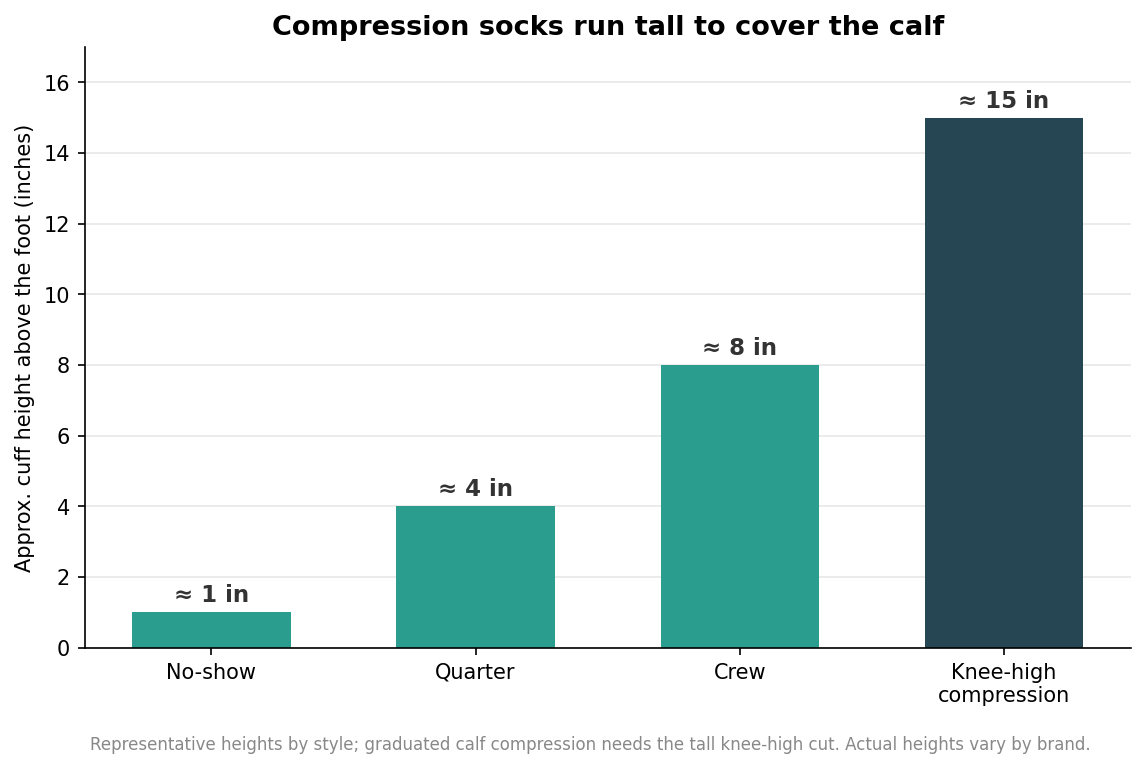
Because the compression gradient has to act along the whole calf, a real graduated sock is cut knee-high, far taller than the no-show and quarter-height socks most runners train in. That height is not a style choice; it is what lets the pressure taper from ankle to just below the knee. The chart below shows roughly how the common sock heights stack up. It also explains why compression socks feel like a different garment to pull on: the long, engineered cuff has to stay up without digging in, which is a real design challenge and a common failure point in cheap pairs. If a “compression” sock only reaches mid-calf, it cannot deliver a proper gradient, whatever the label claims.
Specifying a custom pair
Custom compression socks are a different order from custom crew socks, mostly because fit is not optional. Regular socks forgive a loose size; a compression sock that is too big delivers no meaningful pressure, and one that is too small can be uncomfortable or even counterproductive. That means sizing by calf circumference, not just shoe size, so any custom program needs a clear size chart and ideally a measuring step for the wearer. On construction, expect a nylon-dominant knit with a healthy share of spandex or elastane, since the stretch fiber is what creates and holds the graduated pressure. Decoration is more constrained than on a cotton crew sock: fine logos knit into a tight technical sock can close up, so keep marks bold and simple, an issue worth confirming with a knit sample before a full run. Minimums and lead times track other custom knitwear, generally running a few weeks after you approve a sample, longer for a first order that needs a new size set dialed in. Get the compression level and the calf fit right first, and the branding second, and you will end up with a sock that does what the label promises rather than just looking the part.